
Visible From Space
Bunkers, fortress cities, and the recurring fantasy that money can substitute for society

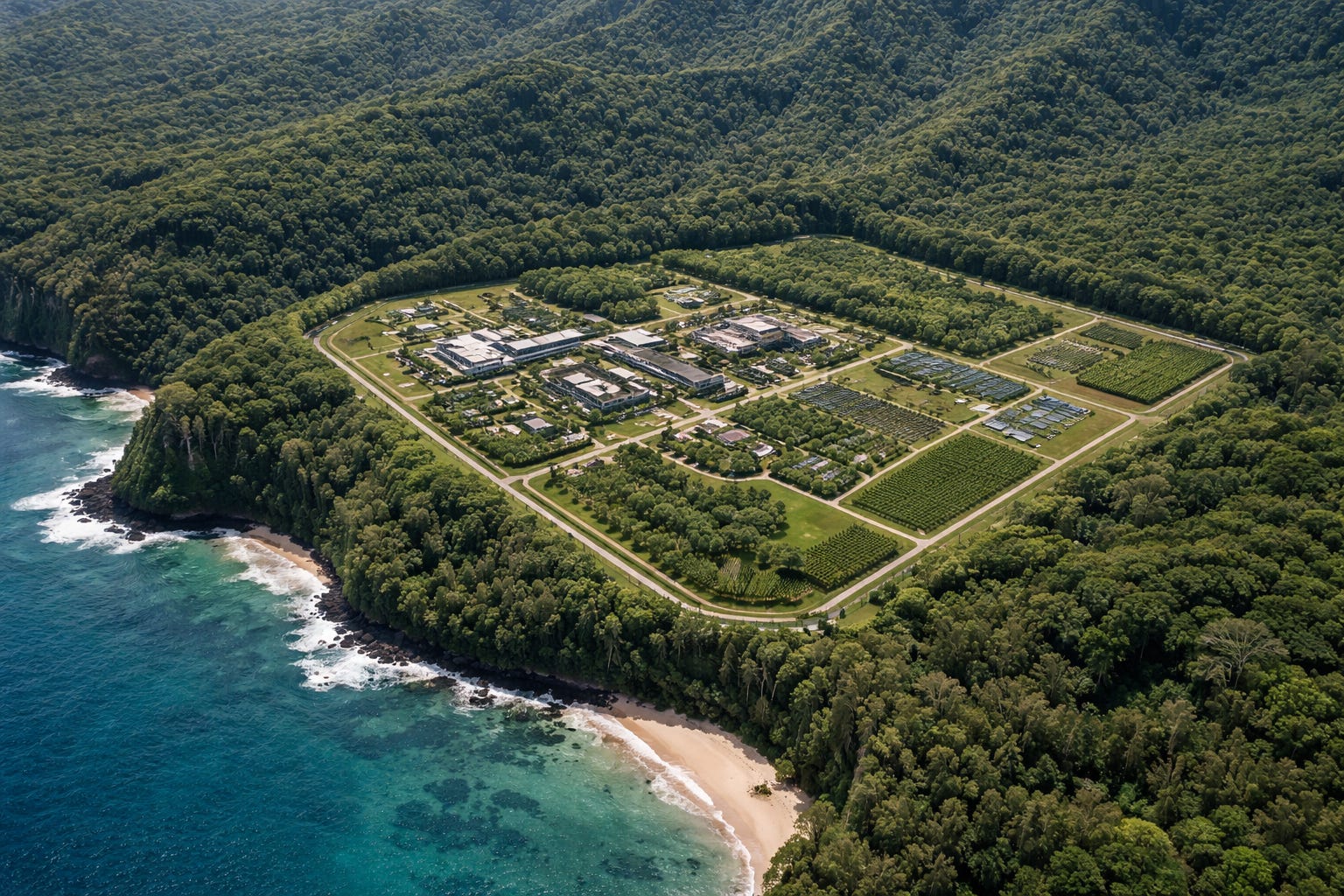
When more than just a couple of people ask me about something, I take that as a crude but useful signal that the idea is circulating widely enough that separate minds are converging on the same worry.
Lately one worry has a consistent shape: bunkers, fortress cities, “freedom cities,” and the broader fantasy behind them. The fantasy is not really about architecture. It is about exit. It is the belief that a small number of wealthy actors can step out of the social contract, let everyone else absorb the risk, and then re-emerge later into whatever is left.
There is no scalable escape from society that does not still depend on society. Bunkers are short-term shelters. Fortress cities are a political dream that collides with law, labor, logistics, and legitimacy. The only model that even begins to resemble a long-duration hedge is land: a large, water-secure estate with agriculture, energy, and a managed population. Even that is not an “exit.” It is governance by another name.
Anything real leaves a footprint. If someone is doing this at a scale that matters, it is visible. Not as a secret blueprint. As permits, grading, roads, water systems, power systems, labor housing, shipping patterns, local politics, and eventually imagery. If you believe in fortress cities and permanent enclaves, you are also implicitly claiming that large, complex infrastructure can be concealed. It cannot.
The Exit Fantasy
There is a reason this topic is sticky. It is not only about wealth. It is about a sense, increasingly common, that the civic machinery is failing and the rules are not being applied evenly. When people feel that the law does not bind the powerful, it becomes natural to imagine the powerful preparing to step away from everyone else.
The problem is that “stepping away” is not a technology problem. It is a systems problem. You can buy concrete. You can buy land. You can buy generators. What you cannot buy is the full stack of civilization without re-creating the thing you claim to escape: a society with legitimacy, incentives, norms, and enforcement.
Bunkers Are Pause Buttons
A bunker is not a civilization. It is a pause button; a bet that the dangerous phase is temporary and the outside world will eventually resume enough function to make exit safe.
Bunker thinking usually carries an unspoken timeline. You retreat. You wait out the panic. You emerge to a world where the rule of law has reasserted itself, roads exist again, supply chains exist again, and someone still has both the power and the will to restore order.
That is why bunker talk rises during periods of social stress. It is psychological reassurance as much as engineering. It says: step out of the storm until the storm is done.
But “until the storm is done” is not a stable planning horizon. If you take “collapse of structure” seriously, even as a low-probability scenario, a bunker becomes a strange strategy. The physics are harsh. The logistics are worse.
People reach for hydroponics as the clever answer, as if you can shrink an ecosystem into a concrete box and call it solved. Hydroponics is efficient on land use. It is not magically independent. It leans hard on continuous power, filtration, pumps, sensors, replacement parts, sterilization, and nutrient inputs. Grow lights are not optional if you want reliable calories. Air handling is not optional if you want people to remain alive. Water systems have to stay clean. Filters clog. Membranes foul. Batteries age. Seals degrade. Everything that keeps a sealed environment stable drifts toward failure.
Submarines work because they are embedded in an industrial civilization that builds them, maintains them, resupplies them, and rotates crews. A bunker is the opposite: a stationary bet that you can outlast the industrial base that makes your bunker viable.
The failure mode bunker planners miss. A bunker assumes the occupants control the timeline. You go in when you choose. You come out when you choose.
That only works if the outside world agrees to it, explicitly or implicitly.
Once you seal yourself underground, you fix your location and make yourself predictable. If the outside world stabilizes into any coherent local order, the people outside do not have to storm the bunker to defeat it. They can monitor it, block it, and wait. They may do that out of anger, out of caution, or simply because they conclude that someone who fled the social contract is not entitled to re-enter it on their own terms.
In that scenario, the bunker stops being refuge. It becomes containment, and the release condition is controlled by someone else. Even without violence, the bunker’s timeline can be extended beyond the plan. The “short-term retreat” becomes “indefinite delay.” The bunker may still function as a sealed habitat for a while. The strategy has still failed.
So bunkers ask for two unlikely gifts at once: that your closed system remains intact long enough, and that the world outside eventually returns to a condition that welcomes your reappearance.
Say you have a 5,000 square foot bunker. You will want power and water, but anything you must place outside the shell becomes a point of leverage. If the wellhead and pumps are outside, then control of the surface can become control of your water. If your power plan depends on exposed solar arrays, then control of the surface can become control of your electricity. If you put the generator and fuel inside, that may reduce vulnerability, but it competes directly with living space and stores.
Air is the quiet version of the same problem. Most bunkers are not truly closed-loop habitats; they depend on intake, filtration, and powered ventilation. If the surface environment is hostile or simply uncooperative, the bunker’s “short-term retreat” can be extended beyond the plan without anyone ever needing to breach the door. Food storage and waste handling push in the same direction: the longer you intend to stay, the more space and external interfaces you need, and the more those interfaces can be constrained from outside.
So capacity is not a simple square-foot calculation. In the tightest, short-duration “storm shelter” mode, 5,000 square feet might hold something like 20–60 people. In any longer-duration plan, once you reserve space for power, water treatment, ventilation, food, medical, and spares, the realistic number drops—often into something like 10–25 people if you are trying to avoid constant crisis and collapse of privacy. It starts to resemble the cabin area of a yacht, but without the deck—the place where pressure, crowding, and social hierarchy quietly become complication of the life-support system.
Fortress Cities Collide With Reality
If the bunker is a pause button, a fortress city is the dream of permanence. It is the belief that you can build a self-contained polity where wealth is protected, rules are optional, labor is available, and legitimacy is either unnecessary or can be manufactured.
This is where the fantasy collides with scale. A city is not a collection of buildings. It is water, power, sanitation, food, waste, health care, security, governance, supply chains, and continuous maintenance. People who talk about fortress cities often talk like software engineers: spin up a new instance, migrate the good users, ban the trolls. The real world does not fork that cleanly.
If you attempt to build a city that is meaningfully independent inside the United States, you collide with sovereignty. You do not get to create a jurisdiction exempt from federal law, insulated from state authority, and free to define its own labor and civil-rights regime without triggering a fight that swallows the project.
Even if you avoid that collision by branding it as a “freedom city” or a special zone, the same core problem returns through the back door: labor and legitimacy.
A city must be staffed. If it is designed as an insulated privilege enclave, it needs a permanent working population to keep it alive. Either those workers have real exit rights and leverage, in which case the enclave is not feudal. It is a high-cost company town competing for labor. Or those rights are curtailed, in which case you have built a coercive system that rots internally and attracts external hostility.
Coercive systems do not become stable by adding concrete. They become brittle.
Then the most practical point returns: anything large enough to matter is visible. A genuine fortress city is visible in budgets, permits, hiring, shipping, land-use change, roads, power infrastructure, satellite imagery, and local politics. It cannot be hidden. It is not a secret plan. It is an announcement.
And even if you could build the walls, you still have to eat. Cities don’t run on concrete and ideology; they run on calories, water, fuel, parts, and people. Food production is land, time, soil, irrigation, storage, and constant maintenance. Ranching and farming are not “set and forget.” They are weather, disease, repair, logistics, and labor. If you are not running an economy with your surroundings, you are importing it through a supply chain. If you think you are outside the social contract, you still need a workforce to plant, harvest, repair, guard, and haul. That workforce either has real agency, or your enclave becomes a coercive project—brittle internally, obvious externally, and permanently at risk of being treated as an occupied asset rather than a sanctuary.
The Plantation Model
The only plausible long-duration hedge is land: a large estate with water, agriculture, energy, storage, and a managed population. Not a bunker. Not a city. A rural node that can, in principle, ride out disruption with fewer moving parts.
Even this is not an “exit.” It is governance.
First, it is not invisible. Food production at scale leaves signatures. Roads leave signatures. Water systems leave signatures. Labor housing leaves signatures. Power systems leave signatures. If it is robust enough to be resilient, it is legible to the outside world.
Second, it is not apolitical. The moment “self-sufficiency” depends on other human beings, you are back in governance. If you attempt to run it as court-and-labor, you create a three-way stability problem: the court, the working population, and the guard class that exists to keep the court safe.
The guard class must be privileged enough to be loyal, but excluded enough to remain subordinate. That tension is not a moral critique. It is a classic failure mode. If guards side with workers, the court is finished. If guards side with the court too harshly, sabotage becomes cheap and effective. If everyone loses faith at once, the enclave collapses from within.
The only way around that is legitimacy. Not branding. Legitimate participation, fair compensation, workable exit rights, and a relationship with surrounding communities that resembles an economy rather than an occupation. Which means the “exit” still depends on the thing it claims to escape: society.
Now the part people tend to skip: if the plantation model is the most realistic long-duration hedge, the number of truly viable examples is small.
Not “large landowners.” Not “people with ranches.” Not “someone with a bunker and a few acres.” I mean holdings that plausibly check all the boxes at once: large enough to buffer shocks, agriculturally productive, water-secure, legally consolidated, politically stable, and developed on a timeline that suggests deliberate long-term intent rather than a lifestyle estate.
When you apply that filter, the list of publicly visible candidates shrinks hard. One of the most documented examples in mainstream reporting is the large, long-running land consolidation on Kauaʻi1, which has expanded over time into the “thousands of acres” range and includes significant on-site development and underground hardened structures.
Such an operation is not a weekend project. Even at a modest scale, it implies a standing population large enough to keep the place running when things go wrong: people to plant, tend, harvest, preserve, and repair; people to manage livestock; at least basic medical capability; veterinary capability if you expect animals to be part of the calorie plan; mechanics and electricians; and security, because anywhere you have a community under stress you also have enforcement and conflict resolution. In other words, the “estate” quietly turns into a small town2.
And then the uncomfortable question returns, because it always returns. If you also have a hardened 5,000 square foot bunker for the worst days3, who actually gets inside when the plan is no longer theoretical?
New Zealand4 has also appeared repeatedly in reporting as a destination for “apocalypse insurance,” precisely because it pairs isolation with resources and relatively stable governance5. But even there, conspicuous attempts to build bunker-like estates have run into legal, environmental, and political resistance6.
That scarcity is informative. A durable plantation requires inputs and people. It requires roads, waterworks, power generation, storage, maintenance, housing, and a labor model that does not implode. All of that creates signatures that are difficult to hide and difficult to defend politically.
If large numbers of wealthy actors genuinely believed they needed a permanent exit from society, we would see far more visible consolidation of land and infrastructure than we do. What we mostly see instead are bunkers and short-horizon hedges. They are easier to build, easier to conceal, and easier to rationalize without admitting you are planning for a world that stays broken7.
Why the Message Still Fails to Land
At this point someone usually asks for reassurance. I am not offering it. I am offering constraints.
If wealthy actors are hedging, the important fact is not whether they are buying concrete or land. The important fact is that none of these strategies scale into a durable replacement for a functioning civic order. They can hide for a while. They can reduce personal risk for a while. They cannot build a parallel civilization insulated from the civilization that made them possible.
Then there is the strangest part of the whole subject. The message is not obscure. Our culture has been rehearsing it for a century.
Novelists and screenwriters have explored dozens of variations of this story: bunkers, domes, sealed cities, offshore sanctuaries, mountain enclaves, corporate polities. The plot varies, but the constraints do not.
When the enclave “succeeds,” it succeeds because the author needs it to. Reality is softened to fit the moral or dramatic goal. The hard parts are politely ignored: maintenance, inputs, labor, legitimacy, entropy, human psychology, and the politics of being surrounded by people you excluded.
In every version that treats those constraints honestly, the story ends the same way. The refuge decays. The system fractures internally. Or the enclave is forced back into relationship with the outside world under terms it no longer controls. We all know how the story ends, which is why it is so strange to watch real people flirt with the belief that they will be the exception.
The good news is still the same. Anything real leaves a footprint. You cannot build a separate society in secret. You can only build a shelter and hope the world outside returns to something you can live in again.
And if the world does return, it will not be because a few people hid successfully. It will be because enough people chose to keep civilization functioning when it was easier, and more fashionable, to give up on it.
https://www.wired.com/story/mark-zuckerberg-inside-hawaii-compound/ - Article describing the property.
https://www.change.org/p/stop-mark-zuckerberg-from-colonizing-kauai - Petition to control the overreach of the project.
https://finance.yahoo.com/news/mark-zuckerberg-spent-187-million-191118946.html - Article about the Doomsday Bunker.
https://www.globalmigrationsolutions.com/apocalypse-insurance-why-silicon-valleys-elite-see-new-zealand-as-their-escape-hatch-from-a-world-they-helped-break/ - Article on Apocalypse Insurance
https://www.theguardian.com/news/2018/feb/15/why-silicon-valley-billionaires-are-prepping-for-the-apocalypse-in-new-zealand
https://repository.uclawsf.edu/hastings_international_comparative_law_review/vol45/iss2/3/ - Peter Theil’s New Zealand Citizenship
https://www.newyorker.com/magazine/2017/01/30/doomsday-prep-for-the-super-rich
Well documented and explained. In the best scenarios, if you succeed, you must ask yourself if you will be willing and able to defend yourself. Those who will eventually discover your safe haven will want to partake of your achivement, are you willing to share?